Everything our Moon game gets wrong about physics, on purpose
Billowing dust, glowing craters, shooting stars, a giant Earth. A list of every rule The Sunship breaks, what the real Moon does instead, and why we broke it anyway.
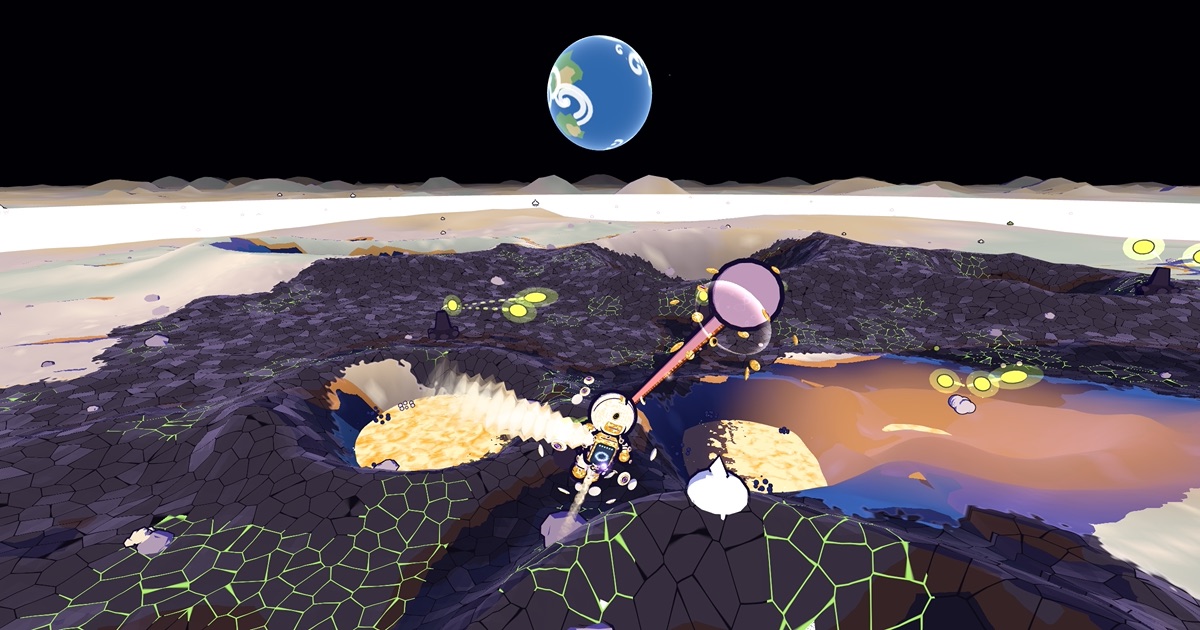
We make a game set on the Moon, and we care a lot about getting it right. The gravity is the real 1.62 m/s². There's no air drag on anything. The rocks you mine are real lunar minerals.
And then, again and again, we break the rules deliberately. Here's every place we know of, what the real Moon would do instead, and why we chose the version we did. If you spot one we missed, tell us.
1. Dust doesn't billow on the Moon
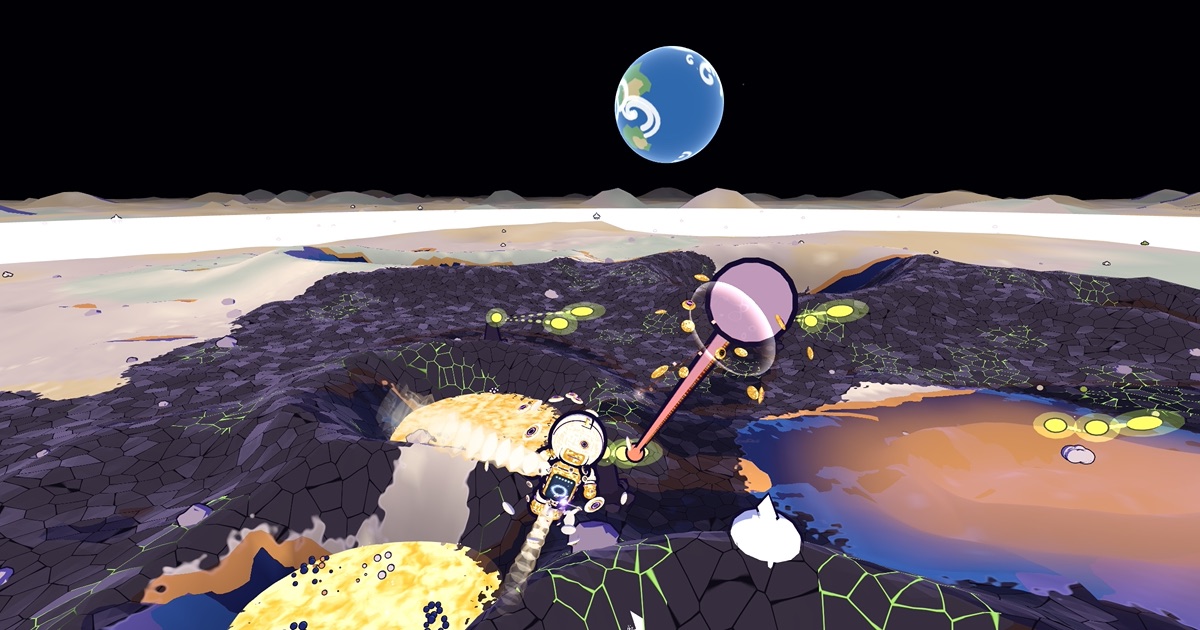
In the game: kick up the ground and it bursts into soft, rolling clouds that hang for a moment and drift apart.
In reality: a cloud needs air to hang in. On Earth, dust billows because each grain is caught by the air around it. On the Moon there's nothing to catch it, so every grain flies off on its own perfect arc and drops straight back down. There's no haze and no drifting.
You can see this in the footage from Apollo's lunar rovers. The dust thrown up by the wheels flies in clean, sharp-edged arcs, like water from a sprinkler, and then it's simply gone.
Why we broke it: real lunar dust is gone in a moment, and on a small screen a spray of grains that drops straight back barely reads as anything. A billowing puff says "you hit something" at a glance. Our dust is drawn in a cartoon style on purpose, so nobody mistakes it for a simulation.
2. A thrown rock wouldn't make a lava crater
In the game: throw a rock and it hits like a meteor. It blasts out a crater floored with glowing molten rock that slowly cools through yellow, orange and red to a dark crust.
In reality: melting rock takes energy, and a thrown rock doesn't have nearly enough.
Our throw tops out at 420 m/s. At that speed, every kilogram of rock carries about 88 kilojoules of energy. Heating lunar rock until it melts takes something like 1.5 megajoules per kilogram, about 17 times as much. You'd need to hit at about 1.7 km/s just to melt the rock you threw, before melting any of the ground.
Real meteoroids are another story. They hit the Moon at tens of kilometres per second. On 17 March 2013, NASA's telescopes caught the brightest lunar impact flash on record. A rock of about 16 kg hit at about 25.6 km/s, carrying about 5.4 billion joules. The flash was visible from Earth without a telescope. NASA's Lunar Reconnaissance Orbiter later found the crater: 18 metres across, from a rock 30 to 40 cm wide.
Why we broke it: a throw that made a modest dent wouldn't be worth throwing. So our craters are sized roughly as if the rock had arrived at meteor speed, about sixty times faster than it really does (our rough estimate). A fist-sized clod blasts a crater a few metres across. A full ball of rubble digs one 25 to 30 metres in radius.
3. Nothing streaks across the sky
In the game: your thrown rock flies as a blur of hot light, like a shooting star.
In reality: a shooting star is a rock burning up in air. With no air on the Moon, meteoroids arrive completely unseen. The only light is the flash at the instant they hit, from rock and vapour heated to thousands of degrees. Since 2006, NASA has recorded hundreds of those flashes on the Moon.
Why we broke it: at 420 m/s, a rock without a trail is invisible. You'd throw it and see nothing until the crater. The streak shows you where it went.
4. The shockwave rolls across the ground like a wave in air
In the game: every big strike sends a bright ring racing out across the plain, shoving loose rocks and you aside.
In reality: there's no air for a blast wave to travel through. What spreads out from a real impact is a cone of flying debris, the ejecta, plus vibrations through the ground itself.
Those vibrations are stranger than anything we show. In 1969, after the Apollo 12 astronauts were done with their lunar module's ascent stage, NASA crashed it into the Moon on purpose. The seismometer they'd left behind recorded the Moon ringing for nearly an hour. Dry, cracked lunar rock carries vibrations with almost no damping, so the Moon rang like a bell.
Why we broke it: our shockwave is the ejecta and the ground shaking rolled into one shape you can see coming. It shoves you without hurting you, so you can read it and dodge it.
5. Particle storms
In the game: now and then, a "particulate storm" rolls in. For eight seconds, small stones rain down around you, a strike every quarter of a second, and your shield has to catch them.
In reality: the Moon does get hit, and more often than scientists used to think. Comparing before-and-after images, a team using the Lunar Reconnaissance Orbiter found 222 new craters of up to 43 metres. That works out to about 180 craters at least 10 metres wide every year across the entire Moon. That's about 30% more than the models predicted. The thrown-out debris churns the top 2 cm of soil every 81,000 years or so, more than 100 times faster than expected.
But 180 a year spread over 38 million square kilometres is very thin. Apart from the rain of debris right next to a big fresh impact, nothing today comes close to a storm like ours, dozens of hits in seconds within a few metres of you. It's the sky's real violence squeezed into eight seconds.
Why we broke it: fun. There's one honest detail, though. The researchers warned that equipment on the Moon must survive debris moving at up to 500 m/s. That's about the speed of our thrown rocks.
6. You can cut a mountain with a laser
In the game: the drone's laser slices through rock, leaving glowing molten seams. Sweep it across a hilltop and the top shears off. The overload fires one huge beam that slices a whole hill.
In reality: a hand-held laser that cuts metres of rock in a second is pure fiction. But melting the Moon with a beam isn't: it's a real road-building plan. In 2023, a European Space Agency project called PAVER used a 12-kilowatt laser to melt simulated lunar soil into glassy, interlocking paving tiles, for roads and landing pads that keep the dust down. On the Moon the laser would be replaced by sunlight focused through a lens a little over two square metres in size.
Why we broke it: cutting through a mountain is the most satisfying thing in the game.
7. Earth is six times too big
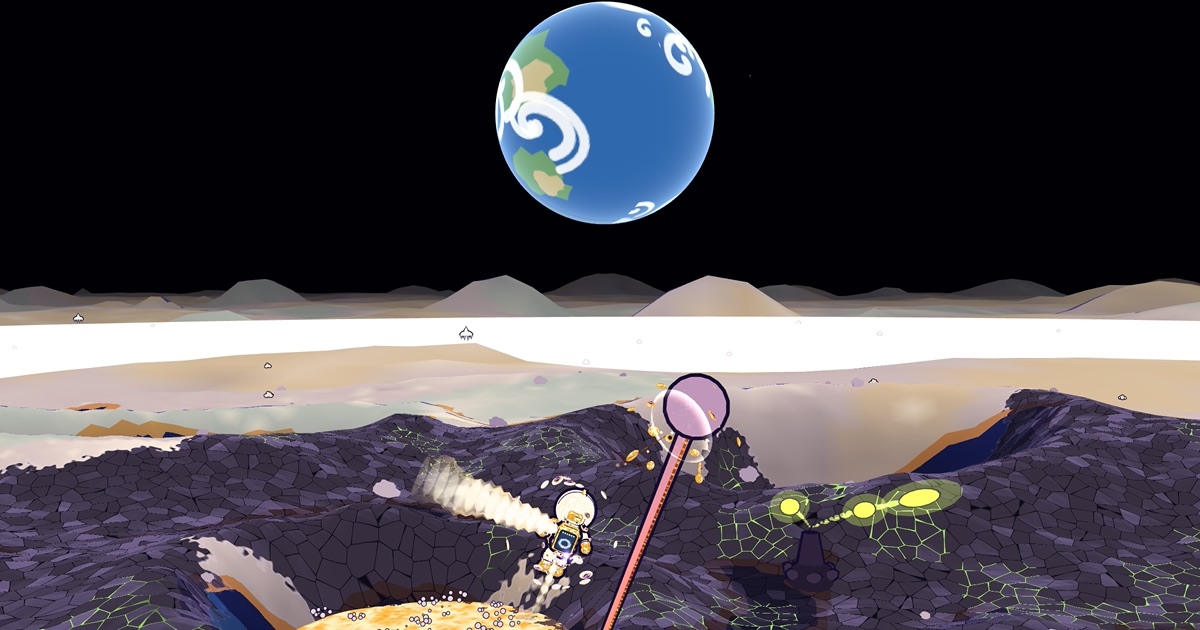
In the game: Earth hangs over the horizon, big and blue, 11° across.
In reality: from the Moon, Earth looks about 1.9° wide, a bit less than your thumb at arm's length. That's huge compared with how the Moon looks from Earth, but on a phone screen it's a blue dot.
Why we broke it: Earth is how you find your way, and the reason the view feels like the Moon at all. We wrote a whole post on Earth from the Moon.
8. The jump is superhuman
In the game: a tap of jump lifts you about 7 metres, and you're in the air for nearly 6 seconds.
In reality: John Young's famous Apollo 16 jump got him 42 cm off the ground. An unsuited person could manage about 2.4 metres.
Why we broke it: boulders. Hopping onto one should feel easy. The details are in how far you could throw on the Moon.
9. The aliens
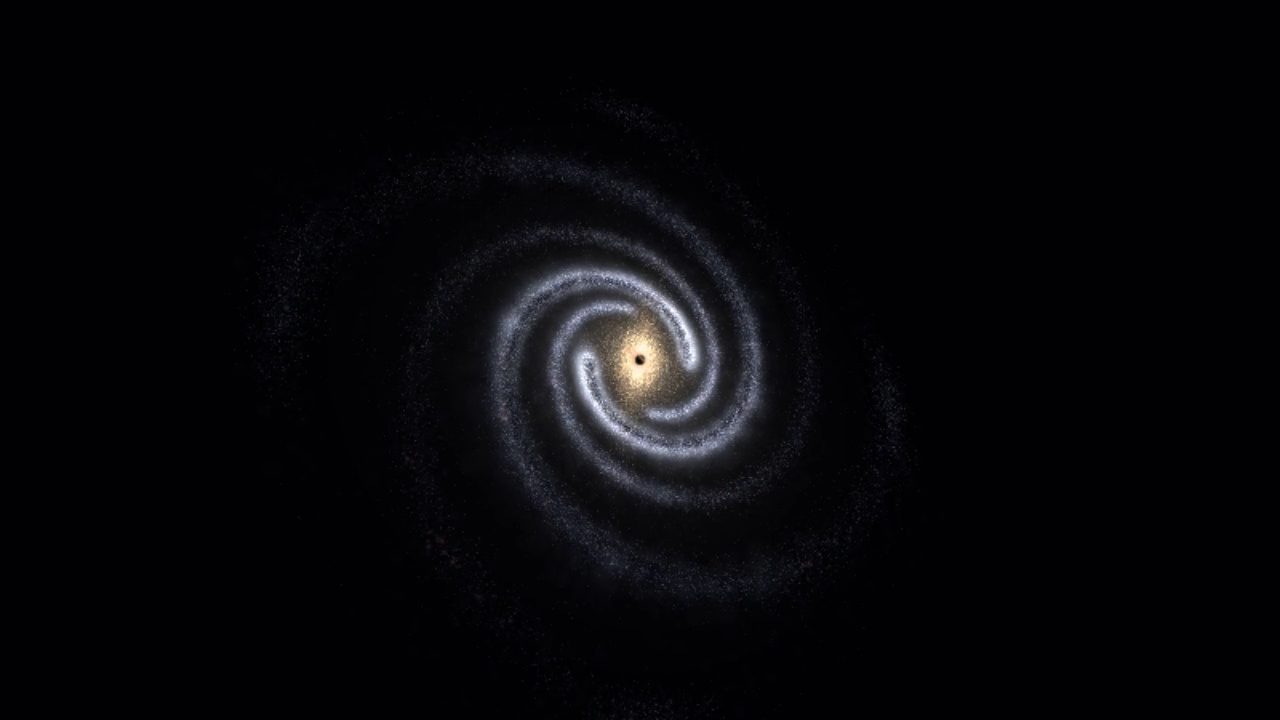
In the game: something that wasn't a comet landed on the crater rim. It grows a nest that spreads across the ground, and if you leave, it keeps building while you're away.
In reality: no one has ever found life beyond Earth.
What we kept anyway: there's no playbook for an alien invasion, so we borrowed the closest real one, invasion biology. Wildlife agencies use a staged plan for invasive species. Find them early and wipe them out while they're few. Once they've spread, contain them zone by zone. Finally, sweep to prove the ground is clear. The cost of acting rises at every stage, and the chance of success falls.
The best real example is South Georgia, in the South Atlantic. Rats brought by 18th-century sealers were wiped out between 2011 and 2015, in the largest rodent eradication ever attempted. It worked because glaciers split the island into separate zones, each cleared without rats creeping back from the next. In 2018, after a survey with more than 4,600 monitoring devices and three sniffer dogs found none, the island was declared rodent-free. The game's alien works on the same logic: the longer you leave it, the harder it gets.
What we kept true
- Gravity. Everything falls at 1.62 m/s², including you. (The rocks you throw are the exception: the field flies them straight.)
- No drag. Nothing slows down in flight.
- Silence. There's no sound through space in the game. Everything you hear is what the suit would pick up: impacts felt through your boots as low thuds, your own equipment rumbling through the suit frame, and the radio.
- Hard light. The Sun is a sharp white disc with no halo or rays, and the sky is black in daylight, because there's no air to scatter sunlight across it.
- The rocks. The minerals are real lunar materials: water ice, ilmenite, anorthosite, olivine and nickel-iron. There's a field guide to them.
Sources
- 2013 lunar impact: 16 kg at 25.6 km/s, 5.4 × 10⁹ J, 18 m crater: Suggs et al., "Large meteoroid impact on the Moon on 17 March 2013" (NASA, 2014), and Robinson et al., Icarus 252 (2015). NASA's monitoring programme had recorded more than 300 flashes by 2014.
- New craters, the 81,000-year overturn and the 500 m/s warning: Speyerer et al., Nature 538 (2016), and NASA's release on it.
- The Apollo 12 impact ringing for nearly an hour: Apollo 12 Mission Report (NASA, 1970), and Latham et al., Science 170 (1970).
- Laser-melted paving: Ginés-Palomares et al., Scientific Reports (2023), ESA's PAVER project.
- South Georgia eradication: South Georgia Heritage Trust.
- Invasion stages: Agriculture Victoria's Invasive Plants and Animals Policy Framework, and the Invasive Species Centre's "invasion curve".
- Energy per kilogram at 420 m/s, melt energy, the speed needed to melt rock, and the crater scaling: our arithmetic and rough estimates.