What can you actually mine on the Moon? A field guide
Water you can drink and burn, rock you can breathe, a metal that fell from the sky, and a gas bought before anyone has mined it. Five real lunar materials, what they're good for, and who's allowed to take them.
The Moon looks like one grey rock. It isn't. Up close it's a patchwork of very different materials, and each one answers a different question for anyone planning to live there: what do we drink, what do we breathe, what do we build with, and what is worth sending home?
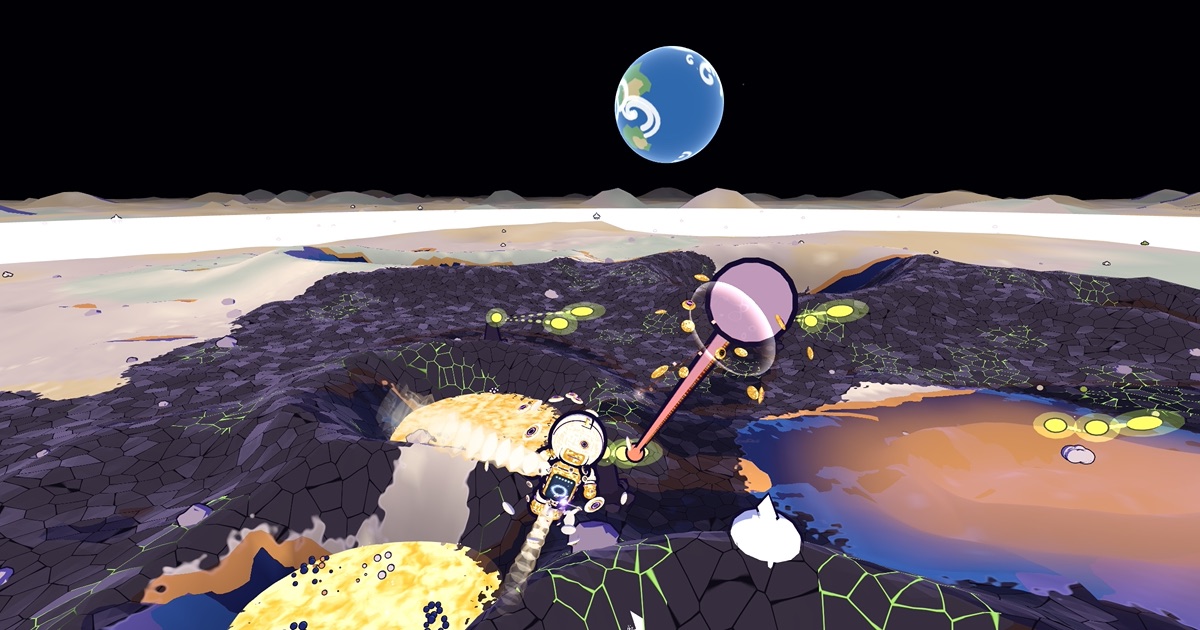
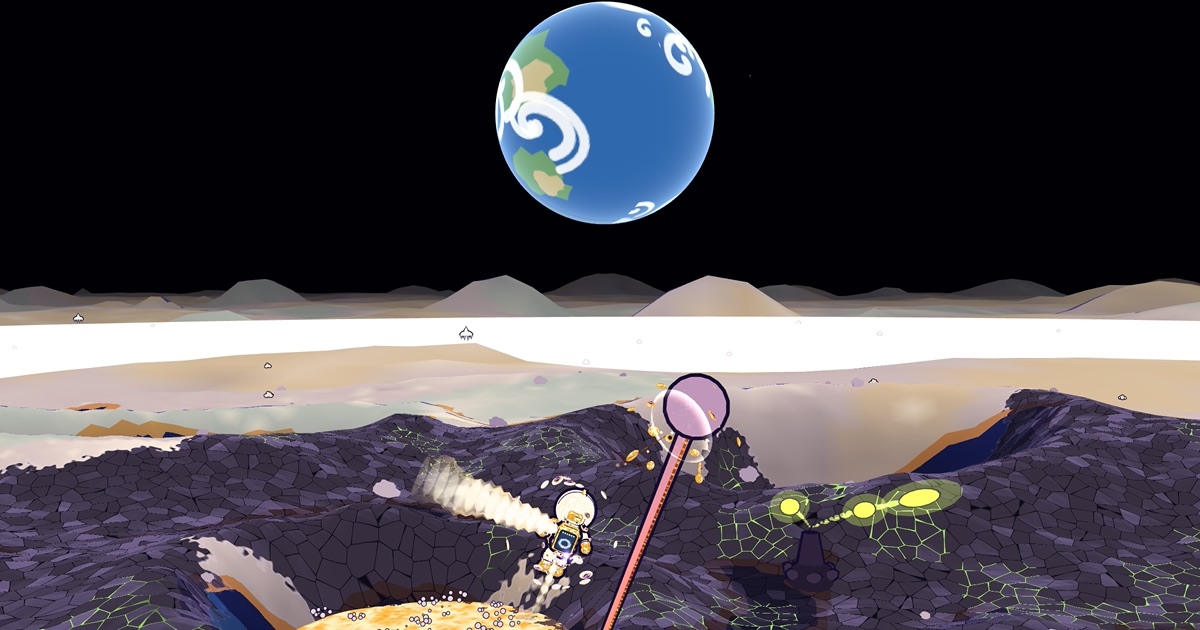
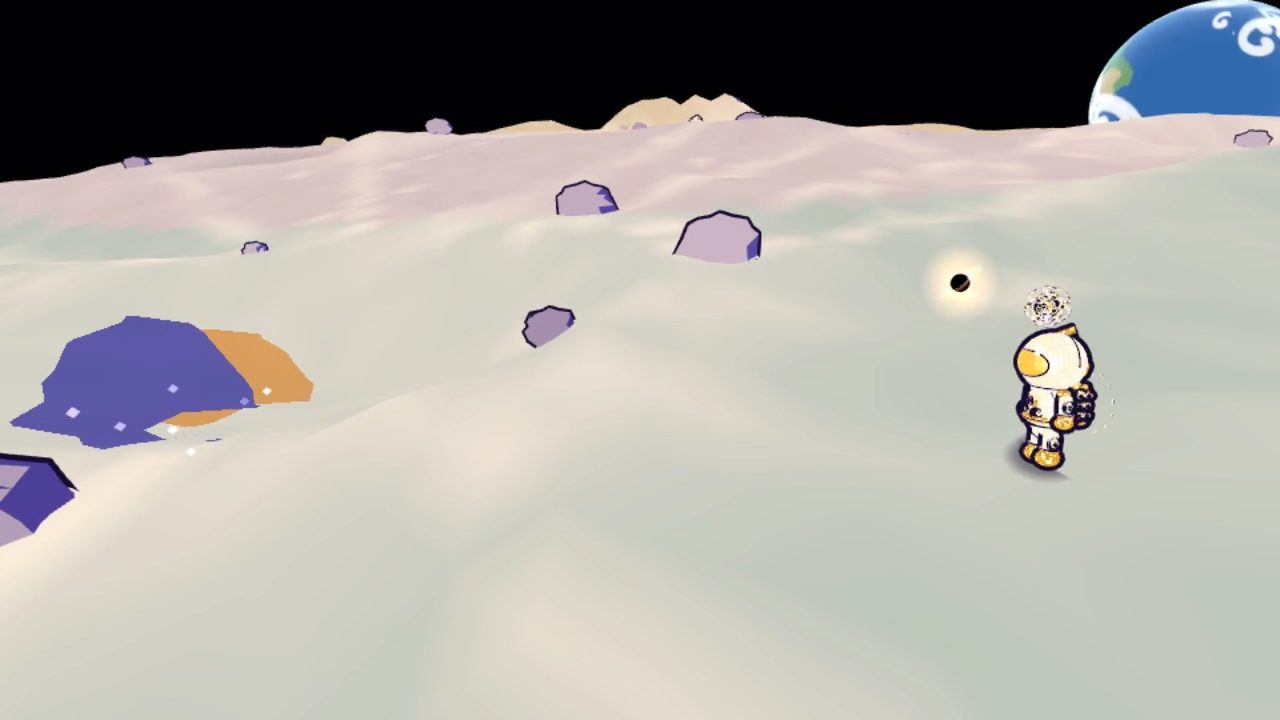
These are the five materials in our game, The Sunship, plus the one everyone asks about. In the game you gather each of them into your pocket, and you can break each one down for energy.
1. Water ice: drink it, breathe it, burn it
Where: in the floors of craters near the poles that never see the Sun.
At the Moon's poles, the Sun skims along the horizon and never climbs high. Deep crater floors there sit in permanent shadow, some of them for billions of years. They're among the coldest places in the solar system. Where NASA's LCROSS probe struck, in the crater Cabeus, the ground is about 38 K, or −235 °C.
Any water molecule that wanders into one of these craters freezes and stays. In October 2009, LCROSS slammed a spent rocket stage into Cabeus and flew a second craft through the plume. It found about 5.6% water by mass in the soil it threw up. There were other frozen chemicals in there too, including carbon dioxide and sulphur compounds.
Why it matters: water is the most useful thing on the Moon. You can drink it. Split it with electricity and you get oxygen to breathe and hydrogen. Burn the hydrogen with the oxygen and you have rocket fuel. A base with ice nearby doesn't need to ship water up from Earth, which costs a fortune per kilogram.
In the game: the ice sits in the shadows on the summits rather than in deep crater floors. That's one of our liberties. The real-world twist is that the sunlit tops of polar peaks are exactly where you'd put your solar panels, right next to the dark craters that hold the ice.
2. Ilmenite: rock you can breathe
Where: the dark plains, the "seas" you can see from Earth.
The dark patches on the Moon are old lava flows. Some of them, especially around the Apollo 17 landing site, are rich in a black mineral called ilmenite, an iron-titanium oxide (FeTiO₃). Some of those basalts are up to a quarter ilmenite.
Why it matters: oxygen. The lunar ground is about 42% oxygen by mass, all locked up in minerals, and ilmenite gives it up more easily than almost anything else. Heat it to about 900–1,050 °C in hydrogen, and the hydrogen pulls the oxygen out of the iron oxide to make water: FeO + H₂ → Fe + H₂O. Split that water and you get the hydrogen back to use again, plus oxygen.
Pure ilmenite gives about 8–10% of its mass as oxygen this way. Ilmenite-rich basalt gives about 2–2.5%.
To put that in human terms (our arithmetic, using NASA's planning figure of 0.84 kg of oxygen per astronaut per day): a tonne of ilmenite yields enough oxygen for one person for about three months.
3. Anorthosite: the oldest crust, and aluminium
Where: the bright highlands, most of the Moon's surface.
When the Moon was young, it was covered in an ocean of molten rock hundreds of kilometres deep. As that ocean cooled, a light mineral called plagioclase crystallised and floated to the top, like ice forming on a pond. That floating scum hardened into the Moon's original crust. The rock it made is anorthosite, and it's why the highlands are so bright.
The most famous piece is the Genesis Rock, sample 15415, which Apollo 15 brought back in 1971. It's about 99% plagioclase. Rocks of its kind have been dated to between 4.29 and 4.56 billion years old, almost as old as the solar system itself.
In 2013, researchers found tiny amounts of water in these rocks, about six parts per million, locked inside the crystals. That's a hint that the young Moon was wetter than people had thought.
Why it matters: aluminium. The plagioclase in lunar anorthosite is almost pure anorthite (CaAl₂Si₂O₈), which is about a fifth aluminium by mass (our arithmetic). It's light and strong: good for building. It also melts into glass and ceramics.
In the game: anorthosite is bulky, so it fills your pocket fastest, and gives the least energy.
4. Olivine: the green crystal, honey-brown on the Moon
Where: deeper crustal rocks and old volcanic deposits.
Olivine is a magnesium-iron silicate, (Mg,Fe)₂SiO₄. On Earth it's the gemstone peridot, and it's what makes the green sand of Papakōlea beach in Hawaii.
Its most famous lunar sample is troctolite 76535, picked up by Apollo 17 in 1972. NASA's own catalogue calls it "without doubt the most interesting sample returned from the Moon". It's about 35–37% olivine, with the rest mostly plagioclase. It formed deep in the crust, cooled extremely slowly, and has barely been damaged since. Its olivine isn't green: it's honey-brown. In 2009, scientists studying its magnetism found evidence that the young Moon had a magnetic field made, like Earth's, by a molten, churning core.
Apollo 15 also found tiny beads of green volcanic glass, sprayed out by "fire fountains" of lava more than three billion years ago. Their green comes from iron, the same element that tints olivine.
Why it matters: magnesium and iron for building, and silicon. On Earth, olivine has a surprising second life: it soaks up carbon dioxide as it weathers, and people are testing crushed olivine as a way to pull CO₂ out of the air.
5. Nickel-iron: metal that fell from the sky
Where: scattered everywhere, delivered by meteorites.
The Moon has no air to slow meteorites down, so for four billion years they've hit its surface at full speed. Some of them were metal: the nickel-iron alloy of iron meteorites. Bits of that metal are mixed through the lunar soil as tiny grains, and some of it can be picked out with a magnet.
Why it matters: it's ready-made metal. Almost everything else on the Moon has its metal locked up in oxides, which takes a lot of energy to break apart. Nickel-iron is already metal, so it's useful for tools, structures and electronics with less processing.
In the game: nickel-iron is the densest material, and gives the most energy per unit.
The one everyone asks about: helium-3
Helium-3 is a light form of helium. The Sun blows it out in the solar wind. Earth's magnetic field and air keep it away from our ground, but the Moon has neither, so over billions of years it soaked into the top layer of lunar soil.
It's famous because it could fuel a kind of nuclear fusion that produces very little radioactive waste. The catch is how little there is: only about 10 to 20 parts per billion in the soil. You'd need to dig up and heat a million tonnes of regolith to get 10 to 20 kilograms (our arithmetic). Also, the fusion reactor that would burn it hasn't been built yet.
The surprise is that someone is buying it anyway, and not for fusion. Helium-3 is essential for dilution refrigerators, the machines that cool quantum computers to within a hundredth of a degree of absolute zero. In September 2025, the Finnish company Bluefors agreed to buy up to 10,000 litres a year of lunar helium-3 from the American startup Interlune, for delivery from 2028 to 2037. It's one of the first deals ever made for a resource still sitting on the Moon.
Who's allowed to mine it?
This is less settled than you'd think.
- The Outer Space Treaty (1967) says no country can claim the Moon or any part of it. It doesn't clearly say whether you can own what you dig up.
- The United States passed a law in 2015 saying US citizens can own resources they extract from space. Luxembourg, the United Arab Emirates and Japan have passed similar laws since.
- The Artemis Accords (2020), now signed by more than 50 countries, state that extracting resources doesn't count as claiming territory, so the US position fits within the treaty.
- The Moon Agreement (1979) would have declared the Moon's resources the common heritage of humanity. None of the big space powers has ratified it.
The short version: you probably can't own the crater, but you can probably own the ice you scoop out of it.
Sources
- LCROSS water, 5.6 ± 2.9% by mass: Colaprete et al., Science 330 (2010). Cabeus at about 38 K: Paige et al., Science 330 (2010).
- Oxygen by hydrogen reduction of ilmenite, 900–1,050 °C, 8–10% and 2–2.5% yields: NASA JSC, Lunar News, March 1997. Regolith about 42% oxygen by mass: NASA Technical Reports Server 20210019592.
- Genesis Rock 15415 and water in lunar anorthosite: Hui et al., Nature Geoscience 6 (2013).
- Troctolite 76535 composition and description: C. Meyer, Lunar Sample Compendium (NASA, 2011). Its record of an early lunar dynamo: Garrick-Bethell et al., Science 323 (2009).
- Helium-3 abundance of 10–20 ppb: published regolith analyses of Apollo samples. Bluefors–Interlune agreement: Bluefors and Interlune press release, 16 September 2025.
- Outer Space Treaty (1967); US Commercial Space Launch Competitiveness Act (2015), Title IV; Artemis Accords (2020), Section 10; Moon Agreement (1979).
- Oxygen per person, the aluminium fraction of anorthite, and the helium-3 yield: our arithmetic.