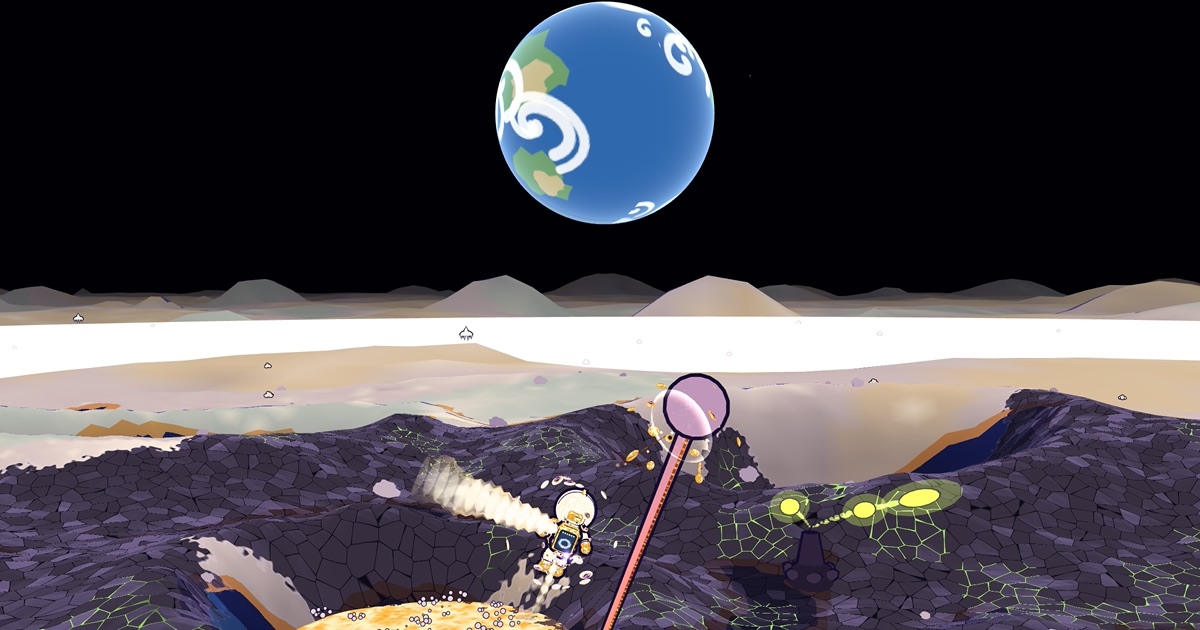
How far could you throw a ball on the Moon?
A good arm sends a ball about a kilometre on the Moon, and it stays up for half a minute. The physics, the Apollo golf shots, and a calculator to try your own throw.
A strong throw on the Moon goes about a kilometre. The ball hangs in the black sky for more than half a minute, climbs higher than a sixty-storey building, and comes down exactly as fast as it left your hand. It doesn't curve, wobble or fade, because there's no air to push on it.
Most people guess the answer is "six times further than on Earth", since the Moon's gravity is a sixth of ours. That's roughly right, but it hides most of what's interesting. Here's the full picture, worked out step by step.
The one number that matters
The Moon pulls everything down at 1.62 m/s². Earth pulls at 9.81 m/s². That's the only difference that matters for a throw, except one: the Moon has no air.
With no air, a thrown thing follows a perfect parabola. The distance it covers on flat ground is:
distance = speed² × sin(2 × angle) ÷ gravity
It goes furthest at 45°. Gravity is on the bottom, so the weaker the pull, the further the ball goes: on the Moon, 9.81 ÷ 1.62 = 6.06 times as far as on an airless Earth. It also stays up 6.06 times as long and climbs 6.06 times as high.
The catch is that real Earth has air, and air takes a big bite out of a fast throw. So against an actual throw in a park, the Moon wins by even more than six times.
What that means for an actual arm
Here are three throws, all at 45°. The Earth figures assume no air, which is generous to Earth; real throws fall short of them.
| Throw | Speed | Moon: lands | Moon: in the air | Moon: highest point | Earth, no air: lands |
|---|---|---|---|---|---|
| A gentle lob | 10 m/s | 62 m | 8.7 s | 15 m | 10 m |
| A decent amateur | 25 m/s | 386 m | 22 s | 96 m | 64 m |
| An elite thrower | 40 m/s | 988 m | 35 s | 247 m | 163 m |
For scale, the fastest pitch ever measured in Major League Baseball was 105.8 mph, about 47 m/s. So 40 m/s is a great arm, not a superhuman one.
Look at the last row again. That ball is in the air for 35 seconds and peaks at 247 metres, higher than most skyscrapers. You could throw it, turn round, walk a few steps, and still turn back in time to watch it come down.
Try your own numbers:
Throw it yourself
| On the Moon | On Earth, with no air | |
|---|---|---|
| Lands | ||
| In the air | ||
| Highest point |
Vacuum physics on both: on the Moon that's the whole story; on Earth air drag cuts a real throw well short.
The catch: the suit
In practice you wouldn't get anywhere near 40 m/s, because the best arm on Earth is the wrong arm on the Moon.
An Apollo suit was pressurised like a balloon. Bending a joint meant squeezing the air inside it, so every movement fought the suit. A full overhand throw, which uses the shoulder, elbow, wrist and a twist of the hips, was close to impossible. Astronauts threw in stiff, awkward swings.
The best measured example is jumping, not throwing. On Apollo 16, John Young jumped and saluted the flag for a famous photo. He was off the ground for about 1.45 seconds, which means he left the surface at about 1.17 m/s and rose 42 cm. The suit and backpack weighed as much as he did, so most of his effort went into lifting the gear.
The same 1.17 m/s on Earth would lift you 7 cm. On the Moon it carried a man and his life-support system up past his knees.
The only real sporting record: Alan Shepard's golf
In February 1971, Alan Shepard became the first and only person to hit a golf ball on the Moon. He'd clipped a six-iron head onto the handle of a sample-collecting tool, and swung it one-handed in a suit that barely let him turn.
The first shot went about 24 yards. The second went about 40 yards. Shepard joked over the radio that it went "miles and miles", and the story grew for fifty years. In 2021, imaging specialist Andy Saunders went back to the original footage and pictures with the USGA. He worked out the real distances, and found the first ball lying in a crater next to the "javelin" Edgar Mitchell had thrown.
Saunders also worked out what a pro could do. Golfer Bryson DeChambeau, swinging at his full speed, could in theory hit a ball 3.41 miles on the Moon, with 1 minute 22 seconds of hang time.
Now jump
A good standing jump on Earth lifts you about 40 cm. That takes a take-off speed of about 2.8 m/s. On the Moon, the same push lifts you 2.4 metres, and you're in the air for 3.5 seconds, minus whatever your gear costs you.
Our game is more generous. In The Sunship, a jump launches the cadet at 4.8 m/s, enough for about 7 metres and six seconds in the air. That's more than a person could manage. We decided being able to hop onto a boulder felt right even if it's a little superhuman, and you can keep climbing on the suit's jets.
Where real physics ends and the game begins
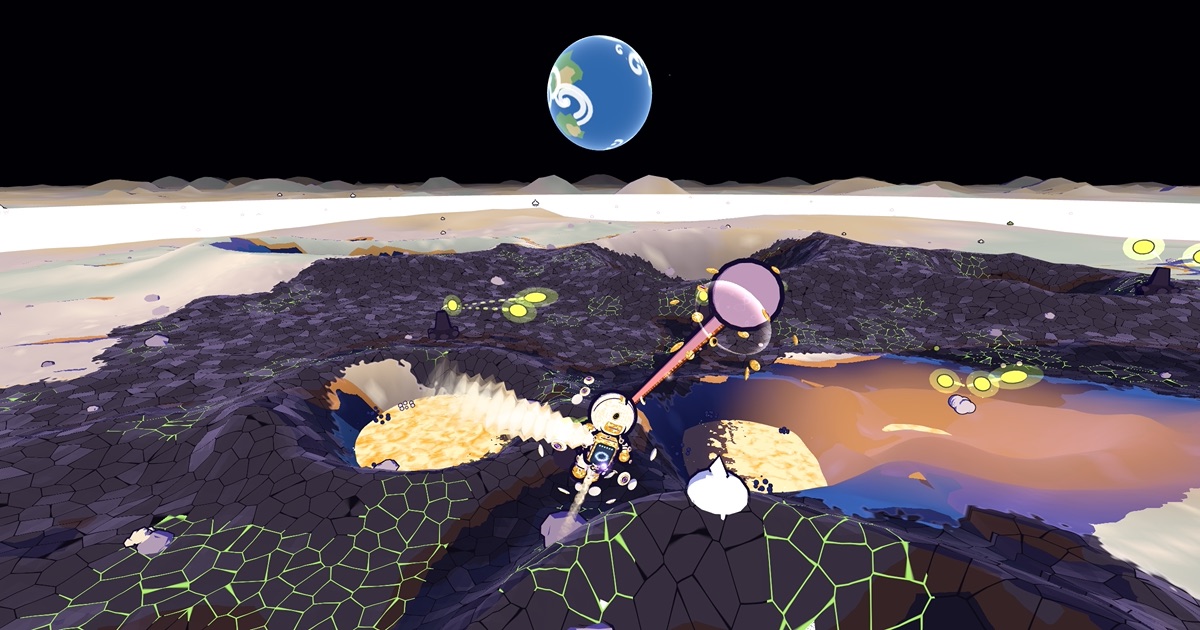
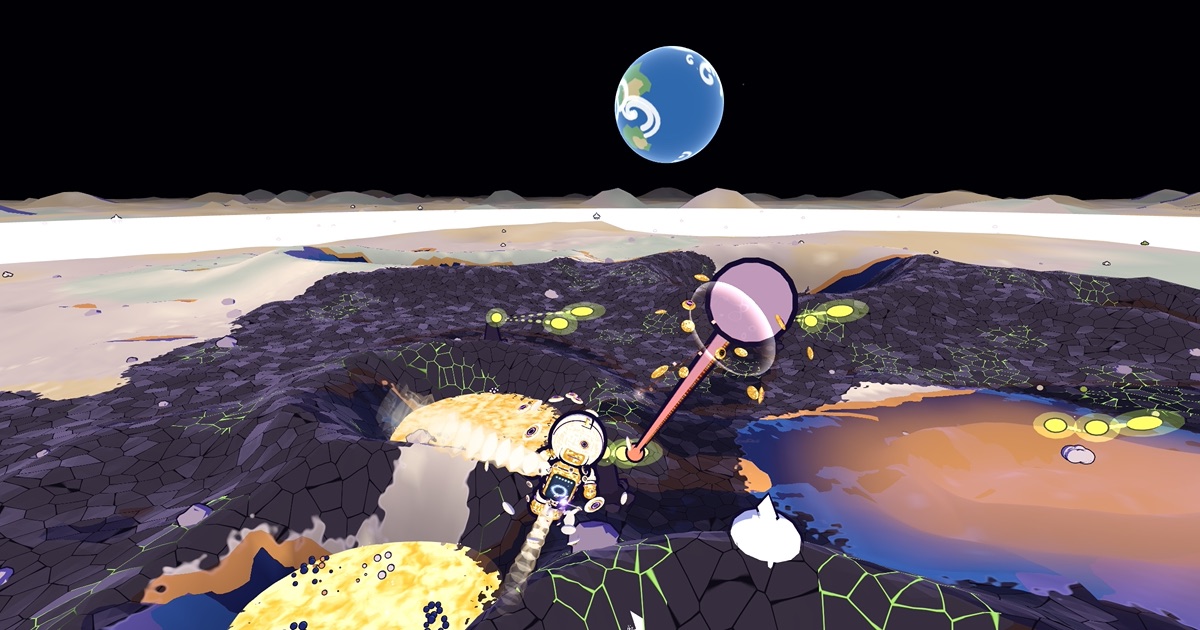
In The Sunship you can grab the ground itself. Hold the gather key on bare rock and the drone at your shoulder digs a pit and packs the rubble into a ball up to 5.5 m across.
Then you throw it, and this is where we break the rules on purpose. A real throw would arc. Ours doesn't: the cadet's field flings the ball dead straight along your aim, accelerating from 40 m/s to 420 m/s in about 0.15 seconds.
Surprisingly, the straight line is barely a cheat. At 420 m/s, a rock heading for a target 300 m away gets there in 0.7 seconds. In that time the Moon's gravity pulls it down by only 40 centimetres. At that speed on the Moon, a straight line and a parabola look almost the same.
The craters are where we cheat a lot. A real 420 m/s rock would dig a modest hole. Ours blast out lava-floored craters with a shockwave racing across the plain, because watching your throw land like a meteor is the point.
There's a longer post on everything the game gets wrong on purpose.
Could you throw something into orbit?
Yes, if you could throw fast enough. The Moon's orbital speed at the surface is about 1.68 km/s. That's fast for a hand, but slow next to Earth's 7.9 km/s. A rock thrown sideways at that speed, with no mountains in the way, would circle the Moon and come back to you from behind about an hour and 48 minutes later.
Throw at 2.38 km/s and it never comes back. That's lunar escape speed. It's why serious proposals for mining the Moon talk about launching cargo with electric rails rather than rockets: it takes so little to leave.
Sources
- Lunar gravity 1.62 m/s²: NASA Moon fact sheet.
- John Young's jump salute, 1.45 s, 1.17 m/s, 0.42 m: Apollo Lunar Surface Journal, Apollo 16, 120:25:42.
- Shepard's golf shots, 24 and 40 yards, and the DeChambeau estimate: Andy Saunders with the USGA, February 2021, reported by the USGA, the BBC and Ars Technica.
- Fastest MLB pitch, 105.8 mph: Aroldis Chapman, 2010.
- Throw distances, hang times, the 40 cm drop, the orbit period and the game comparisons: our arithmetic from the formulas above (orbit: √(GM/R) with the Moon's GM = 4,904.9 km³/s² and R = 1,737.4 km).