Does Earth rise and set on the Moon?
Mostly no. From most of the near side, Earth hangs in one spot for billions of years. But at the edges and the poles it bobs up and down, and an Earthrise there takes more than a day.
Stand anywhere on the side of the Moon that faces us and look up. Earth will be in the same place in the sky tomorrow, next week and next year. It doesn't rise or set. It just hangs there, turning.
The famous Earthrise photo from Apollo 8 in 1968, with blue Earth climbing over the grey lunar horizon, was taken from a spacecraft in orbit. The Earth wasn't rising: the camera was moving. On the surface you'd almost never see that.
Almost. The interesting part is the exceptions.
Why Earth stands still
The Moon is tidally locked: it turns once on its axis in exactly the time it takes to go round Earth once, about 27.3 days. That's why we only ever see one face of it.
Flip it round and the same lock holds from the Moon's side. If one face always points at Earth, then from anywhere on that face, Earth stays at the same point in the sky. Stand in the middle of the near side and Earth is straight overhead, forever. Stand halfway to the edge and it's halfway up the sky. Stand right at the edge and it sits on the horizon.
It's not perfectly still: libration
The lock isn't perfect, for two reasons.
First, the Moon's orbit is an ellipse. It speeds up when it's closer to Earth and slows down when it's further away, but it spins at a steady rate. So for part of each month the spin runs a little ahead of the orbit, and for the rest it runs a little behind. From the Moon, Earth drifts east and west by up to 8.16°.
Second, the Moon's axis is tilted about 6.7° to its orbit. Over a month, its north and south poles take turns tipping toward us. That moves Earth up and down by up to 6.87°.
Put the two together and Earth traces a slow loop in the lunar sky, about 16° wide and 14° tall, once a month. The two wobbles run on slightly different clocks, so the loop never quite closes. This rocking is called libration. It's why, over time, we get to see 59% of the Moon's surface from Earth, not just half.
For most of the near side, that loop is all the movement Earth ever makes. Near the edges, it's enough to make Earth set.
Where Earth really rises: the edges and the poles
Stand near the edge of the near side and Earth sits close to the horizon. The libration loop carries it a few degrees up and a few degrees down, so sometimes it's in the sky and sometimes it's below the horizon.
The lunar south pole, where NASA's Artemis astronauts are heading, is one of these places. From there, Earth sits right on the horizon, and the up-and-down wobble lifts it above and drops it below. NASA's planning documents put it at about half of every month in view at the pole itself, with hills and crater rims blocking or helping depending on where you stand.
Earthrise at the pole is slow. The up-and-down wobble moves Earth at most about 1.6° a day. Earth looks 1.9° wide from the Moon, so it takes more than a full day to clear the horizon from first light to last. (That's our arithmetic, from the libration figures.)
A few high places near the pole are lucky. JPL modelled the view from two peaks there, Malapert Mountain and a peak in the Leibnitz range, and found they see Earth 100% of the time. They're high enough that the wobble never drops Earth below their horizon.
That's not trivia. With Earth below the horizon, you can't radio home. So NASA is building lunar relay satellites (the LCRNS programme) to cover the gaps, and mission planners prize sites with a constant view of Earth.
The far side never sees Earth
The far side, often wrongly called the "dark side", gets as much sunlight as the near side. What it never gets is Earth. You could live your whole life there and never see it once.
That makes it very quiet for radio telescopes, and very hard to talk to. When China landed Chang'e 4 on the far side in 2019, the first landing there ever, it needed a relay satellite called Queqiao parked beyond the Moon to pass messages home. Queqiao-2 did the same in 2024 for Chang'e 6, which brought back the first rocks from the far side.
Earth has phases too, and they're the opposite of the Moon's
From the Moon, Earth goes through phases like the Moon does for us, always the opposite one. When we see a full Moon, the Moon sees a "new Earth", dark against the sky. When we see a thin crescent Moon, the Moon sees a nearly full Earth.
You've seen this effect yourself. On a crescent Moon, the "dark" part often glows a faint grey. That's earthshine: sunlight bouncing off a nearly full Earth, lighting the Moon's night side. Leonardo da Vinci worked this out around 1510.
A full Earth is far brighter than a full Moon. It looks almost four times as wide, so it covers about 13 times as much sky, and it reflects roughly two and a half times as much of the sunlight hitting it. That makes it more than 30 times brighter (our rough arithmetic). On the lunar night side under a full Earth, you could read by it.
And it turns. Earth spins once every 24 hours, so over a day you'd watch continents and weather systems roll across its face, while the Earth itself doesn't move.
What we changed in our game, and why
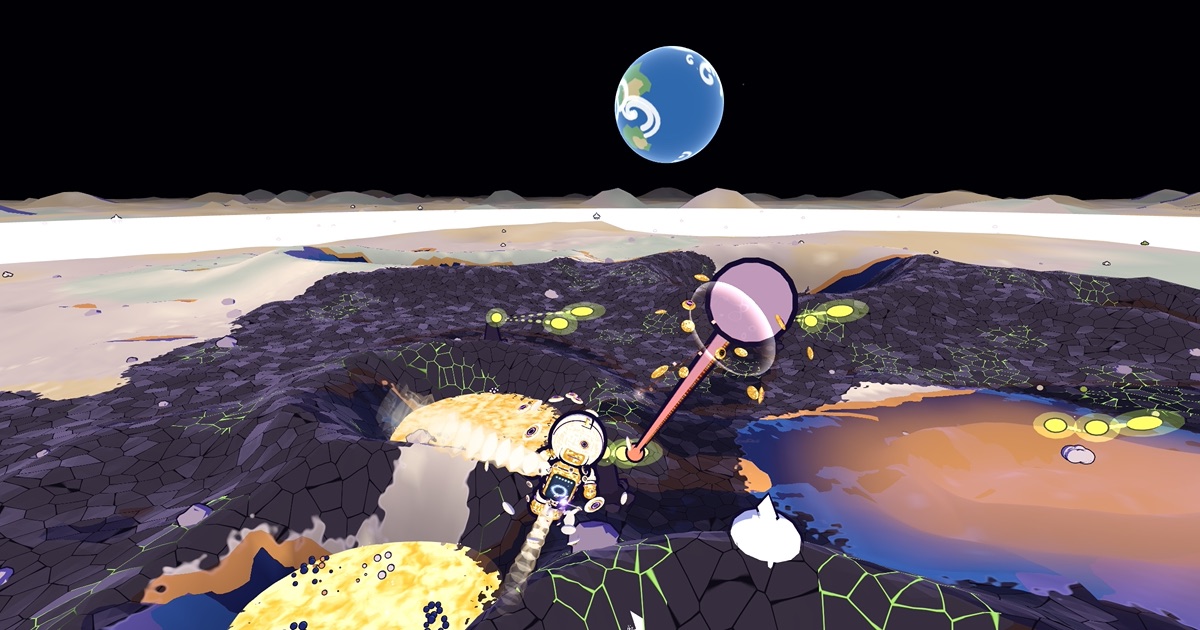
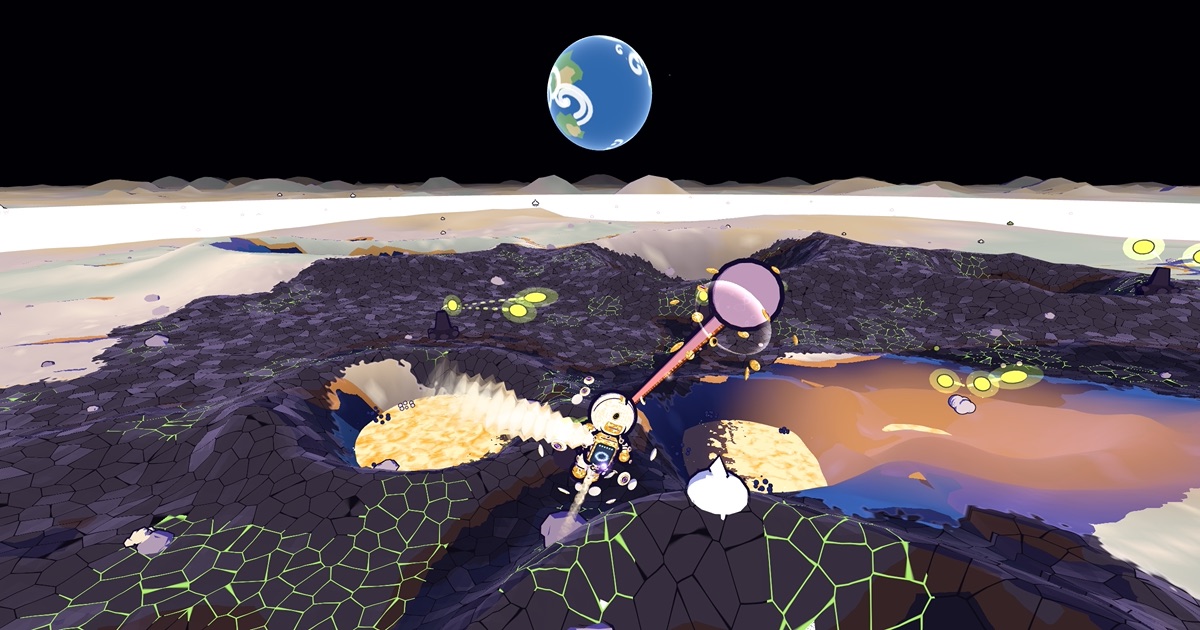
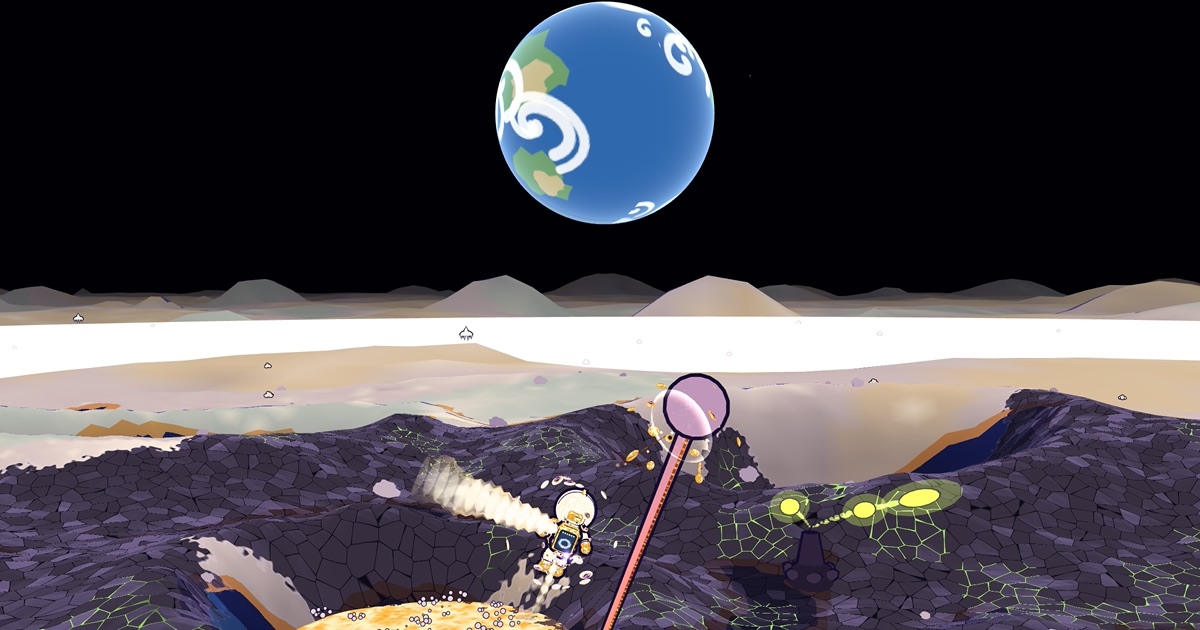
In The Sunship, Earth hangs 8° above the horizon, which is roughly where you'd see it standing near the edge of the near side. It never moves. Over the length of a play session, that's the truth: libration takes a month, so in an hour you'd never notice.
What we did change is the size. From the Moon, Earth really looks about 1.9° wide, a bit less than the width of your thumb at arm's length. On a phone screen that's a blue dot a few pixels wide. We draw it about 11° wide, six times too big, so you can see the oceans and clouds and get your bearings by it. Our screenshots are framed around it.
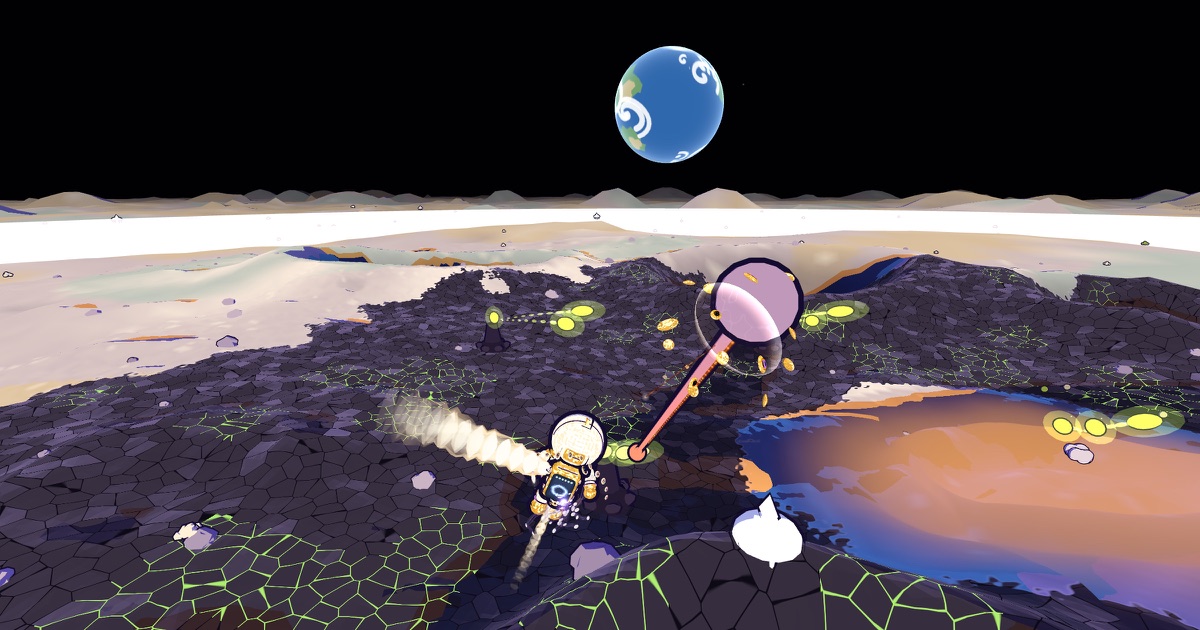
The game opens with the other view: a station in Earth orbit fires you down to the Moon like a comet.
Sources
- Libration limits, ±8.16° in longitude and ±6.87° in latitude; Earth's 1.9° apparent size; 100% Earth visibility from peaks at Malapert and in the Leibnitz range: JPL, Interplanetary Network Progress Report 42-176C.
- Earth in view about half of every month at the south pole, and the case for relays: NASA, Lunar Communications and Navigation Architecture (2024).
- Earthrise: Bill Anders, Apollo 8, 24 December 1968.
- Chang'e 4 and Queqiao: CNSA, 2018–2019. Chang'e 6 and Queqiao-2: CNSA, 2024.
- Leonardo on earthshine: the Codex Leicester, c. 1506–1510.
- Earthrise speed at the pole, Earth's brightness and the game's Earth size: our arithmetic.