How to move the Sun (and take Earth with it)
Moving the Sun sounds absurd until you do the sums. Two real designs for a stellar engine, how fast they'd go, what they'd cost, and why a civilisation might one day need one.
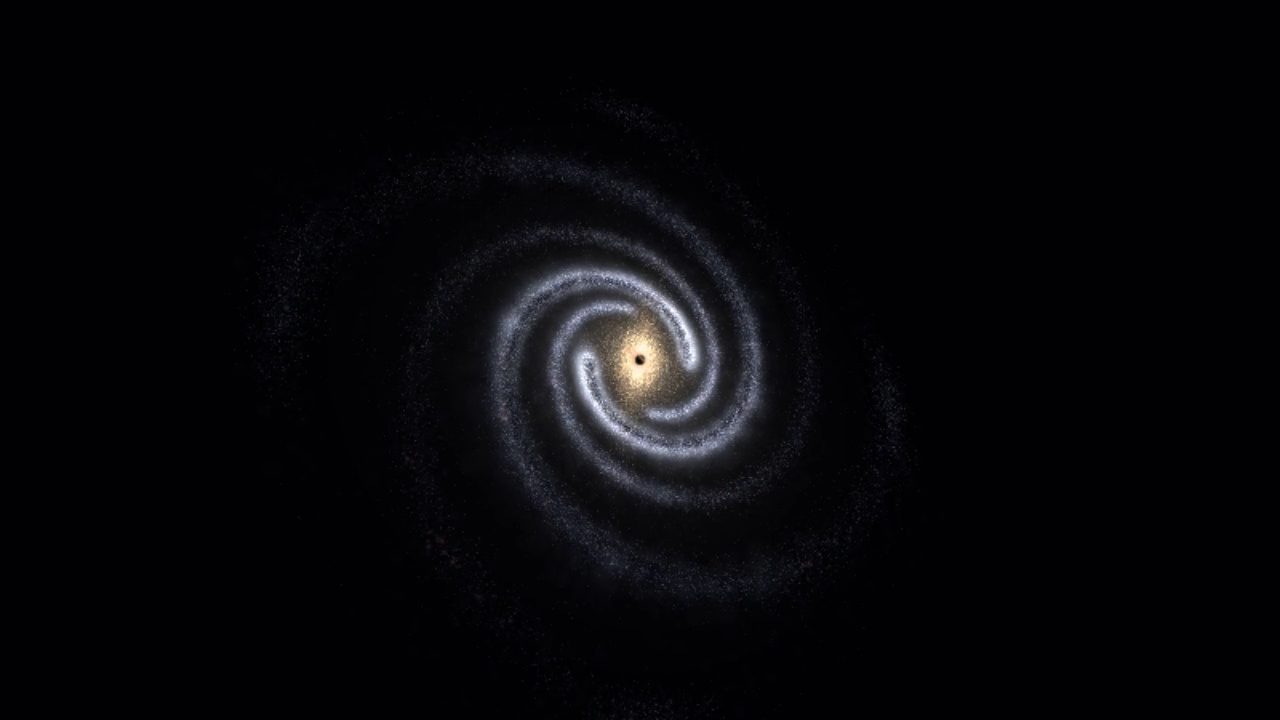
The Sun is already moving. It's going round the centre of the Milky Way at about 230 km/s, and it takes about 230 million years to make one lap. Every star around us is doing the same on its own slightly different path, like cars on a very wide, very slow motorway.
Mostly that's fine. Space is so empty that stars almost never come close. But "almost never" isn't "never", and the galaxy has a very long time to work with. If a civilisation ever needed to get out of the way of something, it would need to steer its star.
That machine has a name: a stellar engine. It has been studied seriously, and the physics works. Here's how.
First, why you'd bother
Some things are worth dodging:
- A nearby supernova. A star exploding within about 10 to 100 parsecs (30 to 300 light-years) could strip away Earth's ozone layer and cause a mass extinction.
- A star passing too close. The Sun is surrounded by the Oort cloud, a vast shell of icy bodies. A passing star can shake comets loose from it and send them falling into the inner solar system.
The second one is already on the calendar. A star called Gliese 710 is heading our way. In about 1.3 million years, it will pass about 10,000 times the Earth–Sun distance from the Sun. That's right through the Oort cloud. Astronomers expect it to send a shower of extra comets inward.
The good news is that threats like these show up thousands or millions of years ahead. The problem isn't seeing them coming. It's having anything to do about it.
You don't need to move the planets
A stellar engine pushes only the Sun. Everything else just follows.
The Sun holds Earth in orbit with a pull of about 0.006 m/s². A stellar engine pushes the Sun with something like 0.000000001 m/s², millions of times weaker. That's too gentle to disturb any orbit. The Sun drifts, and the planets drift with it, like children holding hands with a parent on a slow walk.
So moving the Sun moves the whole solar system. The solar system becomes the ship.
Design one: the mirror (the Shkadov thruster)
Light carries momentum. When the Sun shines equally in all directions, all that push cancels out. Block it on one side and it doesn't.
The Shkadov thruster is a gigantic curved mirror on one side of the Sun. It reflects sunlight back, so more light escapes one way than the other. The imbalance gives the Sun a tiny, steady shove toward the mirror.
The mirror doesn't orbit. It hovers: sunlight pushes it outward, the Sun's gravity pulls it inward, and if it's light enough the two exactly balance. Something held in place like that is called a statite.
How light is "light enough"? Sunlight's push and the Sun's pull both weaken with distance in exactly the same way, so the answer doesn't depend on where you put the mirror. It depends only on how much each square metre of mirror weighs. For a perfect mirror, we work it out to about 1.5 grams per square metre.
For comparison, printer paper weighs about 80 g/m². Kitchen foil is around 50. The thinnest solar sail ever flown in space, Japan's IKAROS, was a polyimide film 7.5 microns thick, and it still weighed several times too much. We don't know how to make this mirror yet.
Even if we could, it would be slow. A Shkadov thruster gives the Sun an acceleration of somewhere around 10⁻¹² to 10⁻¹³ m/s². Over one full lap of the galaxy, that adds up to roughly 100 light-years of course change. It's fine for gently steering over hundreds of millions of years. It's no good for dodging anything.
There's another catch. The planets all orbit in one flat plane. A mirror placed in that plane would shade some worlds and fry others with reflected light, so it has to sit above or below the plane. That limits which ways it can push.
Design two: the tugboat (the Caplan thruster)
In 2019, astrophysicist Matthew Caplan published a much faster design. It's more complex, and it works like this:
- Build a Dyson swarm. That's a huge number of solar collectors orbiting the Sun, together catching a large share of its power. (More on this below.)
- Use that power to lift material off the Sun. Focus the swarm's energy back onto patches of the Sun's surface, heat them, and with magnetic fields draw off far more gas than the natural solar wind carries.
- Collect it. One enormous station, sitting about 0.4 times the Earth–Sun distance from the Sun, gathers the gas with vast electromagnetic fields and splits it into hydrogen and helium.
- Burn the helium in fusion reactors. The exhaust shoots out of the back at about 1% of the speed of light. That's the thrust.
- Fire the hydrogen back at the Sun. Without this second jet, the station would be pulled into the Sun. With it, the station hovers in place.
- Let gravity do the rest. The station's own gravity tugs the Sun along behind it, like a tugboat with an invisible tow rope. The planets follow the Sun.
Caplan's engine can reach about 10⁻⁹ m/s². That's still unimaginably gentle, but sustained for a million years it shifts the Sun about 50 light-years, and in about ten million years it could send the solar system on a completely different path round the galaxy.
What it costs
The engine's push is simple to work out: the mass thrown out each second, times how fast it's going, divided by the Sun's mass. Running those numbers backwards (our arithmetic), the engine needs to throw out about 400 trillion kilograms of gas every second. That's about 270,000 times the natural solar wind.
Over a million years, that adds up to about 0.6% of the Sun's mass, or more than six times the mass of Jupiter. That sounds like a terrible deal, but it isn't. A lighter star burns its fuel more slowly, so a Sun that has lost a bit of mass actually lives longer.
The Dyson swarm: the power plant
Both designs need energy on a scale that's hard to picture, and the Caplan engine needs a Dyson swarm to supply it.
- The Sun puts out about 3.8 × 10²⁶ watts.
- Earth catches about 1.7 × 10¹⁷ watts of that, about one part in two billion.
- All of humanity runs on about 2 × 10¹³ watts. That's about one ten-thousandth of what lands on Earth.
A Dyson swarm is the obvious next step: not a solid shell (which would be unstable), but a swarm of separate collectors in orbit, catching most of the Sun's light.
Where do you get the material? The usual answer is to take apart Mercury. It's close to the Sun, so power is plentiful. It's rich in metal, it has weak gravity, and it has no air. Researchers Stuart Armstrong and Anders Sandberg argued in 2013 that starting with a single square kilometre of collectors, using the power from each batch to build the next, a swarm could be finished in roughly a human lifetime. That's optimistic, but exponential growth is a powerful thing.
On astronomer Nikolai Kardashev's scale of civilisations, using a whole star's output makes you Type II. Humanity today rates about 0.73 on Carl Sagan's version of the scale, not yet even Type I.
Where would we go?
Even with a Caplan engine, actually travelling to another star takes hundreds of thousands of years. Starting from rest, reaching Alpha Centauri, 4.4 light-years away, would take something like 370,000 years (our arithmetic, ignoring the motion of the stars themselves).
So the real payoff isn't a destination. It's a route. Steer the solar system so it passes close to one star after another, and with each pass, send ships across the short gap. Over millions of years a civilisation could settle hundreds of systems without ever leaving home.
Why our game is called The Sunship
The idea of the whole solar system as a ship, with the Sun as its engine, is where our game's name comes from.
The part you can play today is the beginning: a cadet fired from a station in Earth orbit down to the Moon, with a suit and drone that run on one energy supply refilled in the light. You learn to turn sunshine into work before anyone thinks about turning a star into an engine.
Sources
- Kurzgesagt, How to Move the Sun: Stellar Engines (2019), made with Matthew Caplan.
- M. Caplan, "Stellar engines: Design considerations for maximizing acceleration", Acta Astronautica 165 (2019), and the published correction to its Shkadov acceleration factor.
- S. Armstrong and A. Sandberg, "Eternity in six hours", Acta Astronautica (2013).
- Gliese 710's close pass in about 1.3 million years: Gaia data.
- Supernova danger range of 10–100 pc: as cited by Caplan (2019).
- Our arithmetic: the 1.5 g/m² mirror limit (σ = L☉ / 2πcGM☉), the engine's propellant rate and mass budget, the comparison with the solar wind (taken as about 1.5 million tonnes a second), and the Alpha Centauri travel time.